> ## Documentation Index
> Fetch the complete documentation index at: https://omni.fireflo.au/llms.txt
> Use this file to discover all available pages before exploring further.
# AI Agents
> How AI agents work in OMNI: roles, plans and approvals, workflows, stories, activity, usage and AI providers, and how agents share conversations with your team.
The **AI Agents** battery adds agents that work your customers for you. Each agent does
one job — sales or support — on your own AI key. Every action an agent takes is planned,
logged, and waits for a person's approval wherever you say so.
AI Agents also includes [Knowledge](/batteries/knowledge): the FAQs, files and web pages
your agents answer from.
Your plan must include **AI agents**. The plan also sets how many agents can be live at
once. If agents are in your plan but switched off for your account, the screens say so,
and your agents and their history are kept.
## Overview
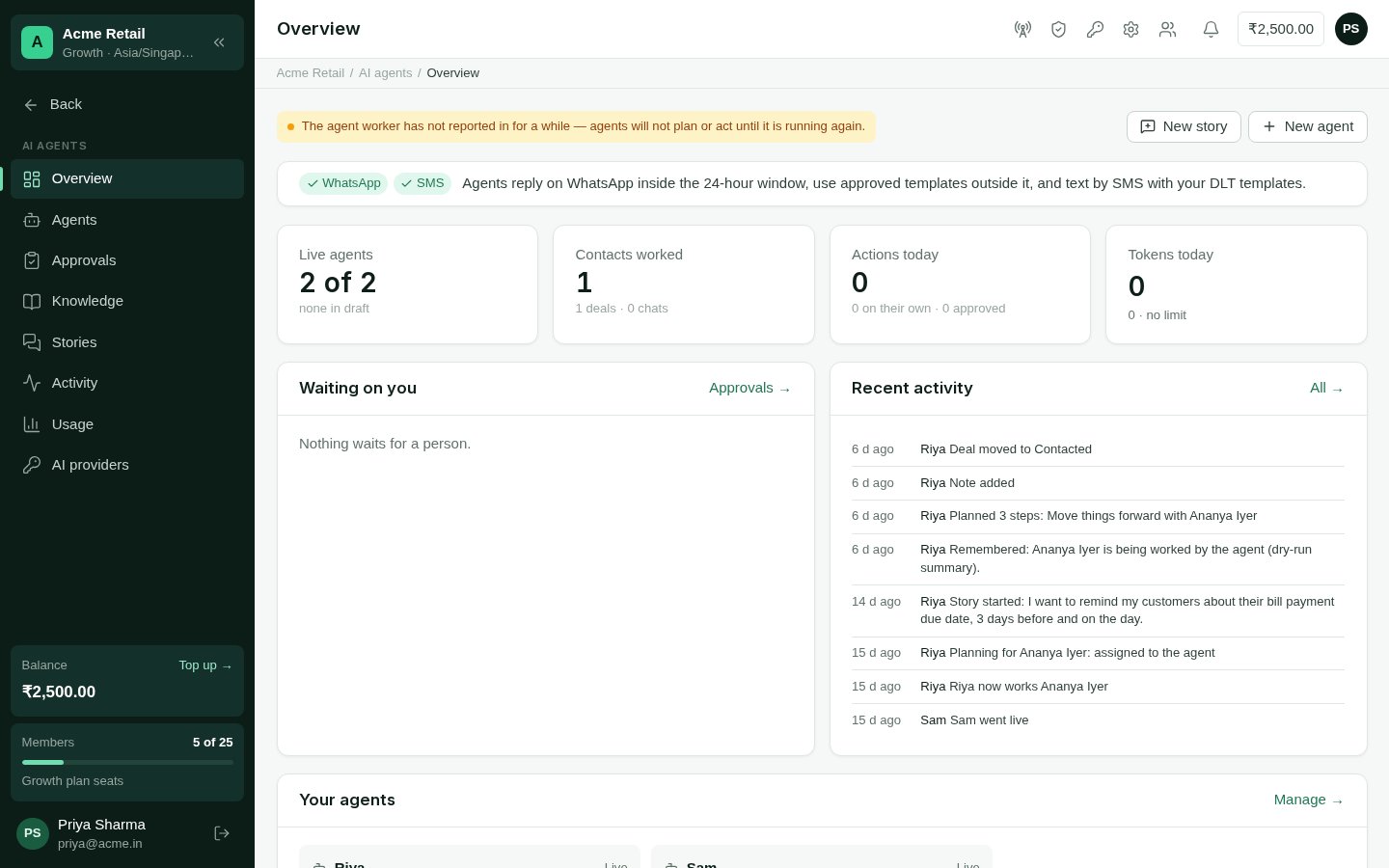
**AI agents → Overview** answers "what are my agents doing right now?"
* Your channels, and which ones agents can use.
* **Live agents**, **Contacts worked**, **Actions today** and **Tokens today**.
* **Waiting on you** — plans to approve and conversations handed over to a person.
* **Recent activity**, and **Your agents** with the channels and pipelines each one works.
A line at the top shows whether the agent worker is running. If it has not reported in
for a while, agents do not plan or act until it is running again.
 ## Roles
Every agent has one role. The role decides which actions it may take and what it does by
default.
| Role | What it does |
| - | - |
| **Sales** (SalesBot) | Works deals on a pipeline: qualifies, quotes, follows up, moves stages, and marks deals won or lost with your approval. |
| **Support** (SupportBot) | Answers customers, resolves what it can, sends reminders and updates, and hands anything sensitive to your team. A support agent can pick up new conversations on its own. |
| **Appointments** (AppointmentBot) | Offers real free times, books, reschedules and cancels appointments, and chases confirmations and no-shows. Available when your plan also includes [Calendar](/batteries/calendar). |
A contact can have one sales agent and one support agent at the same time, but never two
agents in the same role. The role of a live agent cannot change — design a new agent
instead.
## Design an agent
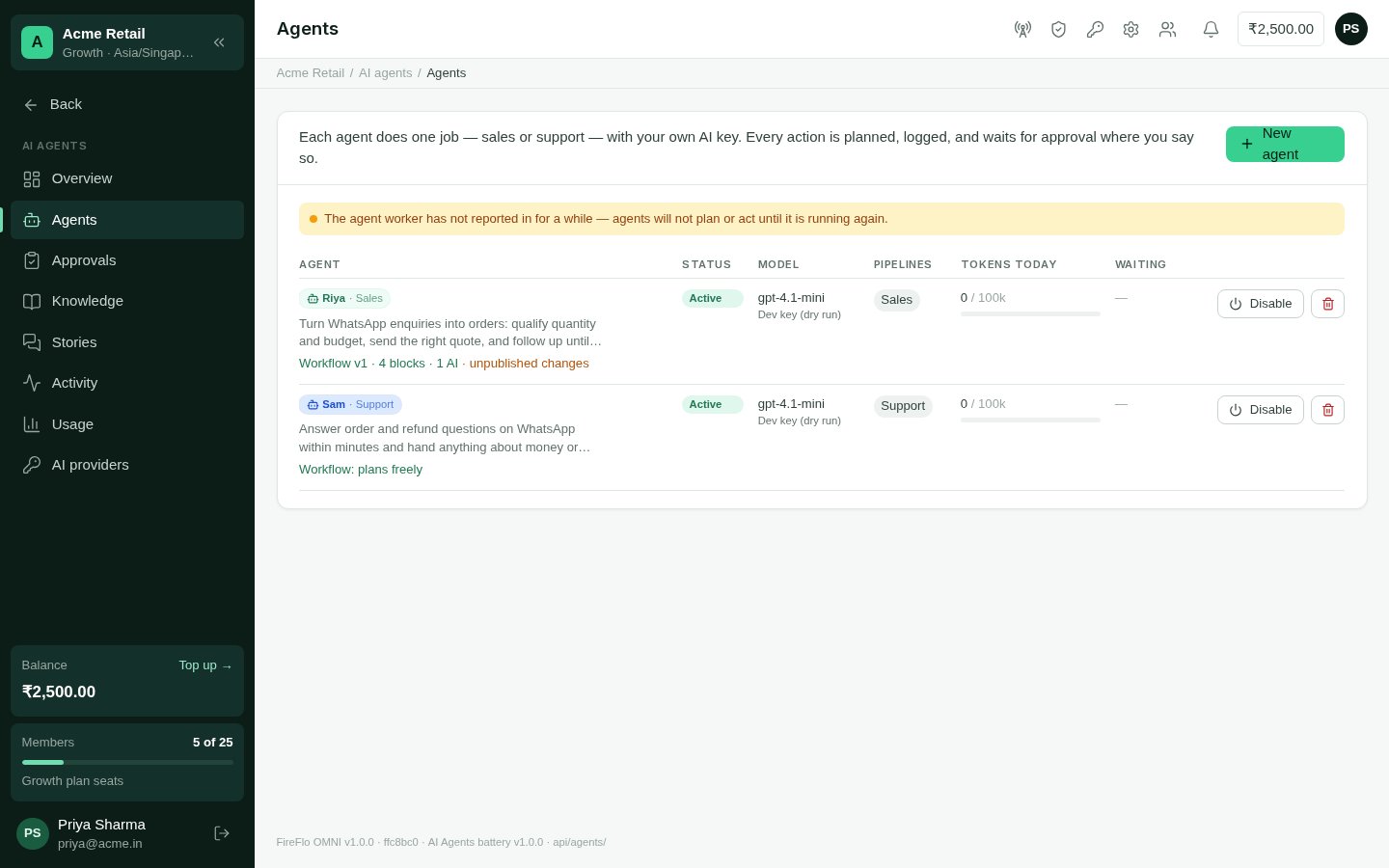
**AI agents → Agents** lists your agents. Choose **New agent** to design one in five steps.
Say in your own words what the agent should achieve — for example, "Answer order and
refund questions within minutes and hand complaints to the team." The agent reads this
every time it plans. Pick the role (OMNI suggests one from your goal) and give the agent
a name. Customers may see the name, so pick a name rather than a job title.
Choose one of your AI keys and a model. You can add a key here too. Tick the box to
confirm that, to plan, agents send contact names, numbers, recent messages and memory
to your chosen AI provider under your own key and its terms. This is asked once per
account.
OMNI sends one small test request to your provider and model, checking it can plan in
the format agents use. Nothing about your customers is sent. Changing the key or the
model later sends the agent back through this step.
Set the instructions, channels, how the agent shares conversations with your team,
knowledge, hand-overs, actions and approvals, when to plan again, working hours and
limits. **Draft my configuration** lets your model suggest settings from your goal; you
pick what to keep. For a support
agent, **Use this workflow** starts a ready-made knowledge-first workflow.
Choose the pipelines the agent works. Each pipeline brings its own strategy — goal,
stage playbooks, approval rules and token budget. Then choose **Go live**. You can
disengage a pipeline at any time; pending work on it stops.
## Roles
Every agent has one role. The role decides which actions it may take and what it does by
default.
| Role | What it does |
| - | - |
| **Sales** (SalesBot) | Works deals on a pipeline: qualifies, quotes, follows up, moves stages, and marks deals won or lost with your approval. |
| **Support** (SupportBot) | Answers customers, resolves what it can, sends reminders and updates, and hands anything sensitive to your team. A support agent can pick up new conversations on its own. |
| **Appointments** (AppointmentBot) | Offers real free times, books, reschedules and cancels appointments, and chases confirmations and no-shows. Available when your plan also includes [Calendar](/batteries/calendar). |
A contact can have one sales agent and one support agent at the same time, but never two
agents in the same role. The role of a live agent cannot change — design a new agent
instead.
## Design an agent
**AI agents → Agents** lists your agents. Choose **New agent** to design one in five steps.
Say in your own words what the agent should achieve — for example, "Answer order and
refund questions within minutes and hand complaints to the team." The agent reads this
every time it plans. Pick the role (OMNI suggests one from your goal) and give the agent
a name. Customers may see the name, so pick a name rather than a job title.
Choose one of your AI keys and a model. You can add a key here too. Tick the box to
confirm that, to plan, agents send contact names, numbers, recent messages and memory
to your chosen AI provider under your own key and its terms. This is asked once per
account.
OMNI sends one small test request to your provider and model, checking it can plan in
the format agents use. Nothing about your customers is sent. Changing the key or the
model later sends the agent back through this step.
Set the instructions, channels, how the agent shares conversations with your team,
knowledge, hand-overs, actions and approvals, when to plan again, working hours and
limits. **Draft my configuration** lets your model suggest settings from your goal; you
pick what to keep. For a support
agent, **Use this workflow** starts a ready-made knowledge-first workflow.
Choose the pipelines the agent works. Each pipeline brings its own strategy — goal,
stage playbooks, approval rules and token budget. Then choose **Go live**. You can
disengage a pipeline at any time; pending work on it stops.
 ### What you configure
| Setting | What it does |
| - | - |
| **Instructions** | Who the agent is, what it may promise and what it must never say. Pipelines add their own playbook on top. |
| **Channels** | Where the agent may message customers: WhatsApp and SMS, when your account has them. |
| **Pick up new conversations** | Support agents only. When a contact nobody is working messages you, this agent takes it. |
| **Step back when a person replies** | If someone on your team replies or takes the thread, the agent pauses for that contact. On by default. |
| **Knowledge** | Which knowledge collections the agent answers from (all of them if you pick none), and how sure an answer must be before it is sent. |
| **Hand-overs go to** | The people a hand-over is assigned to — whoever of them has the fewest open tickets. Pick nobody and hand-overs stay unassigned for anyone to take. |
| **Actions and approvals** | For each action: on its own, needs approval, or off. |
| **Approval mode** | **Approve the whole plan** — if any step needs approval, nothing runs until the plan is approved. **Approve step by step** — automatic steps run on schedule, and a step that needs approval waits when it is due. |
| **When to plan again** | When the customer replies, when the deal changes stage, when a plan finishes, on a schedule, or only when someone clicks **Run**. |
| **Working hours** | Messages are sent only inside these hours; a step due outside them waits for the next window. |
| **Limits** | Daily token limit, most steps in one plan, most messages to one contact per day, and largest broadcast audience. When a limit is reached the agent pauses and says so in Activity. |
### Actions
These are the actions an agent can be allowed. Hand-over can never be switched off: an
agent must always be able to give up.
| Action | Sales default | Support default |
| - | - | - |
| Send a message | Needs approval | On its own |
| Send a WhatsApp template | Needs approval | Needs approval |
| Send a broadcast | Needs approval | Needs approval |
| Ask for a new template | Needs approval | Needs approval |
| Create a deal | On its own | — |
| Move a deal between stages | On its own | On its own |
| Mark a deal won / lost | Needs approval | — |
| Change a deal's value | Needs approval | — |
| Add a note | On its own | On its own |
| Update tags and fields | On its own | On its own |
| Schedule a follow-up | On its own | On its own |
| Close the conversation | — | On its own |
| Hand over to a person | Always on | Always on |
Other batteries add actions of their own when your plan includes them: booking,
rescheduling and cancelling appointments ([Calendar](/batteries/calendar)); finding,
sending, adding and changing products and drafting orders ([Catalogue](/batteries/catalogue));
updating and solving tickets ([Tickets](/batteries/tickets)).
A pipeline's strategy can override an agent's settings for deals in that pipeline, and a
stage can narrow them further: an action a stage does not list is off there.
## How agents reply on each channel
| Channel | How an agent writes |
| - | - |
| **WhatsApp** | Free text inside WhatsApp's 24-hour window. Outside it, an approved template. When no approved template fits, the agent drafts one and asks for it to be submitted — after approval, if your policy says so. |
| **SMS** | Only text that fills in one of your registered DLT templates word for word; only the variable parts change. Anything else is blocked, not sent. When no template fits, the agent drafts one and asks for it to be registered. |
| **RCS** | Agents do not reply on RCS, because RCS carries approved templates, not typed text. |
Template requests an agent drafts appear under **Template requests** on the Approvals
screen. Check the wording, then approve to submit it. OMNI checks every 10 minutes
whether it has been decided; waiting conversations carry on once it is
approved.
## Sharing conversations with your team
An agent steps back as soon as a person steps in.
* **A teammate replies** in the Inbox, or **the conversation is assigned** to a person:
every agent working that contact pauses for them (when **Step back when a person
replies** is on). Anything the agent had planned is cancelled.
* **How long it steps back** is set in the agent's settings: a number of minutes, after
which it takes over again, or 0 to wait until someone hands the conversation back. You
can also choose that it leaves the conversation with the team.
* In the Inbox, a banner shows which agent is working the thread. **Take over** assigns
the conversation to you and pauses the agent. While it is paused, **Hand back now**
returns it to the agent, and **Keep with team** means the agent won't take it back.
* When an agent **hands over** to a person, it pauses for that contact and leaves your
team a short summary — what the customer wants, what it tried and what is needed. With
[Tickets](/batteries/tickets), the summary is a note on the ticket.
Under each AI reply in the Inbox you can mark it **Good answer** or **Wrong answer**; wrong
answers show in [Missing answers](/batteries/knowledge#missing-answers).
On a contact's page and in the Inbox, the **AI agents** card shows who is working the
contact and their current plan, and **Memory** shows what agents know about the person.
Anything your team writes, edits or pins in Memory is never changed by an agent.
## Plans and approvals
Each time an agent works a contact, it makes a **plan**: a goal, the reason for it, and a
list of steps. A plan starts when a contact is assigned to the agent, the customer
replies, a deal changes stage, a follow-up falls due, a person chooses **Run now** on the
contact, or a workflow block asks for it.
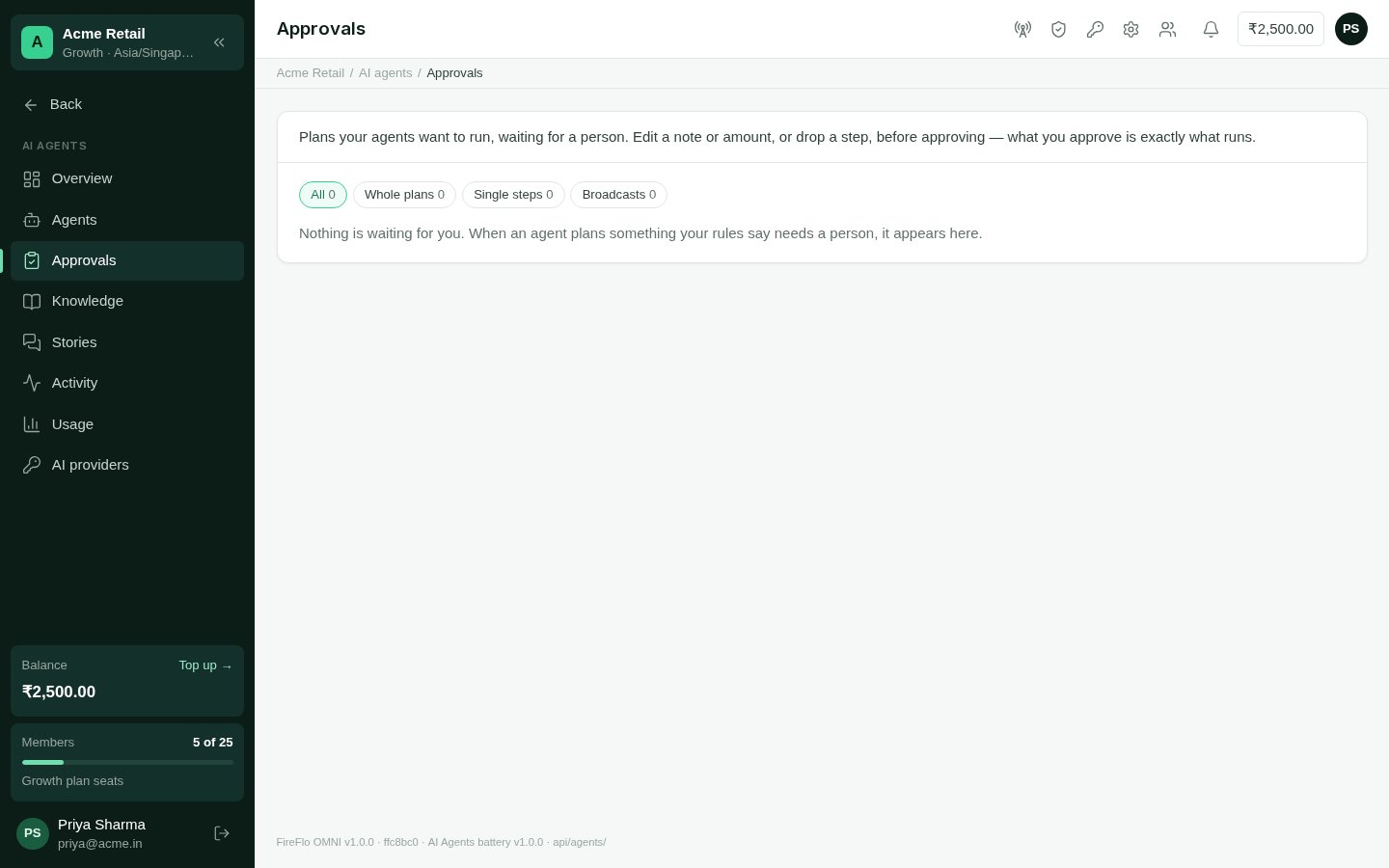
**AI agents → Approvals** lists the plans waiting for a person. You can edit a note or an
amount, or drop a step, before approving — what you approve is exactly what runs. To
reject, tell the agent why; it reads your note the next time it plans for that contact.
An unanswered plan is dropped after a time you set (24 hours by default), not run late.
### What you configure
| Setting | What it does |
| - | - |
| **Instructions** | Who the agent is, what it may promise and what it must never say. Pipelines add their own playbook on top. |
| **Channels** | Where the agent may message customers: WhatsApp and SMS, when your account has them. |
| **Pick up new conversations** | Support agents only. When a contact nobody is working messages you, this agent takes it. |
| **Step back when a person replies** | If someone on your team replies or takes the thread, the agent pauses for that contact. On by default. |
| **Knowledge** | Which knowledge collections the agent answers from (all of them if you pick none), and how sure an answer must be before it is sent. |
| **Hand-overs go to** | The people a hand-over is assigned to — whoever of them has the fewest open tickets. Pick nobody and hand-overs stay unassigned for anyone to take. |
| **Actions and approvals** | For each action: on its own, needs approval, or off. |
| **Approval mode** | **Approve the whole plan** — if any step needs approval, nothing runs until the plan is approved. **Approve step by step** — automatic steps run on schedule, and a step that needs approval waits when it is due. |
| **When to plan again** | When the customer replies, when the deal changes stage, when a plan finishes, on a schedule, or only when someone clicks **Run**. |
| **Working hours** | Messages are sent only inside these hours; a step due outside them waits for the next window. |
| **Limits** | Daily token limit, most steps in one plan, most messages to one contact per day, and largest broadcast audience. When a limit is reached the agent pauses and says so in Activity. |
### Actions
These are the actions an agent can be allowed. Hand-over can never be switched off: an
agent must always be able to give up.
| Action | Sales default | Support default |
| - | - | - |
| Send a message | Needs approval | On its own |
| Send a WhatsApp template | Needs approval | Needs approval |
| Send a broadcast | Needs approval | Needs approval |
| Ask for a new template | Needs approval | Needs approval |
| Create a deal | On its own | — |
| Move a deal between stages | On its own | On its own |
| Mark a deal won / lost | Needs approval | — |
| Change a deal's value | Needs approval | — |
| Add a note | On its own | On its own |
| Update tags and fields | On its own | On its own |
| Schedule a follow-up | On its own | On its own |
| Close the conversation | — | On its own |
| Hand over to a person | Always on | Always on |
Other batteries add actions of their own when your plan includes them: booking,
rescheduling and cancelling appointments ([Calendar](/batteries/calendar)); finding,
sending, adding and changing products and drafting orders ([Catalogue](/batteries/catalogue));
updating and solving tickets ([Tickets](/batteries/tickets)).
A pipeline's strategy can override an agent's settings for deals in that pipeline, and a
stage can narrow them further: an action a stage does not list is off there.
## How agents reply on each channel
| Channel | How an agent writes |
| - | - |
| **WhatsApp** | Free text inside WhatsApp's 24-hour window. Outside it, an approved template. When no approved template fits, the agent drafts one and asks for it to be submitted — after approval, if your policy says so. |
| **SMS** | Only text that fills in one of your registered DLT templates word for word; only the variable parts change. Anything else is blocked, not sent. When no template fits, the agent drafts one and asks for it to be registered. |
| **RCS** | Agents do not reply on RCS, because RCS carries approved templates, not typed text. |
Template requests an agent drafts appear under **Template requests** on the Approvals
screen. Check the wording, then approve to submit it. OMNI checks every 10 minutes
whether it has been decided; waiting conversations carry on once it is
approved.
## Sharing conversations with your team
An agent steps back as soon as a person steps in.
* **A teammate replies** in the Inbox, or **the conversation is assigned** to a person:
every agent working that contact pauses for them (when **Step back when a person
replies** is on). Anything the agent had planned is cancelled.
* **How long it steps back** is set in the agent's settings: a number of minutes, after
which it takes over again, or 0 to wait until someone hands the conversation back. You
can also choose that it leaves the conversation with the team.
* In the Inbox, a banner shows which agent is working the thread. **Take over** assigns
the conversation to you and pauses the agent. While it is paused, **Hand back now**
returns it to the agent, and **Keep with team** means the agent won't take it back.
* When an agent **hands over** to a person, it pauses for that contact and leaves your
team a short summary — what the customer wants, what it tried and what is needed. With
[Tickets](/batteries/tickets), the summary is a note on the ticket.
Under each AI reply in the Inbox you can mark it **Good answer** or **Wrong answer**; wrong
answers show in [Missing answers](/batteries/knowledge#missing-answers).
On a contact's page and in the Inbox, the **AI agents** card shows who is working the
contact and their current plan, and **Memory** shows what agents know about the person.
Anything your team writes, edits or pins in Memory is never changed by an agent.
## Plans and approvals
Each time an agent works a contact, it makes a **plan**: a goal, the reason for it, and a
list of steps. A plan starts when a contact is assigned to the agent, the customer
replies, a deal changes stage, a follow-up falls due, a person chooses **Run now** on the
contact, or a workflow block asks for it.
**AI agents → Approvals** lists the plans waiting for a person. You can edit a note or an
amount, or drop a step, before approving — what you approve is exactly what runs. To
reject, tell the agent why; it reads your note the next time it plans for that contact.
An unanswered plan is dropped after a time you set (24 hours by default), not run late.
 ## Workflows
Each agent has a **workflow**: a diagram of blocks that decides what happens in a
conversation, and when the AI is called at all. Open it from the agent's page.
| Kind | Blocks |
| - | - |
| Start | Customer writes · Deal changes stage · Assigned to the agent · Every N hours |
| Rules | Business hours · Keyword · Condition · Wait for reply · A/B split |
| Talk | Send message · Send approved template · Send buttons (WhatsApp buttons, RCS suggestions, or numbered options on SMS) |
| Inbox | Assign to person · Assign to one of · Label conversation · Set priority · Snooze · Close conversation |
| Deals | Create deal · Move deal stage · Update contact · Add note |
| AI | AI decides · AI replies (answers from knowledge, only when sure, citing a source) · AI takes it from here |
| Hand-over | Hand to a person |
Other batteries add blocks when your plan includes them: appointment blocks (Calendar),
**Send products** (Catalogue), **Ticket is**, **Set ticket** and **Add ticket note**
(Tickets), and a start block for someone joining or leaving an audience (Customer data).
Workflows are versioned:
* You edit a **draft**. Checks show anything broken, and how many AI calls each path makes.
* **Test run** a sample message on a channel to see the path it takes. Nothing is sent.
* **Publish** with a short note. Published versions never change; you can compare one with
the draft, restore it as the draft, or roll back to it.
* **Design with AI** proposes a workflow from a brief. **Export JSON** and **Import JSON**
move a workflow between agents or accounts; an import replaces only the draft.
## Stories
**AI agents → Stories** lets you tell an agent what you want in plain words — "remind my
customers about their bill due dates, 3 days before and on the day". Today, stories send
date-based reminders from a list.
Write it the way you would to a colleague. The agent asks for anything it needs.
Upload a CSV or Excel file and point to the phone number column and the date column.
The agent proposes when to send and which approved message to use.
Someone who can approve plans approves it. Rejecting ends the story; nothing is
imported or sent.
Reminder stories go out on WhatsApp first, since templates reach people outside the
24-hour window, and as SMS broadcasts where WhatsApp isn't available. Starting a story
needs permission to change contacts and to send messages, because a story imports contacts
and sends messages in your name.
## Questions about a broadcast
On a broadcast's page, **Ask about this campaign** answers questions about its results in
plain words, on SMS, WhatsApp and RCS broadcasts alike.
## Activity
**AI agents → Activity** is everything every agent did — plans, approvals, actions, AI
calls with their token cost, and anything a guardrail stopped. It is append-only. Filter
it by **Plans & approvals**, **Actions**, **AI calls**, **Stopped** or **Setup**.
Each agent's page has its own plans, log, pipelines, tokens used today and limits.
## Usage
**AI agents → Usage** shows the tokens your agents used on your own AI keys over 7, 14 or
30 days. Your AI provider bills those tokens directly; OMNI never charges for AI.
**Account limits** apply to every agent in the account, on top of each agent's and each
pipeline's own limits:
* **Pause every agent** — no agent plans or acts while this is on.
* **Daily token budget, all agents** — empty means no account-wide limit.
* **Approvals lapse after (hours)** — an unanswered plan is dropped, not run late.
## AI providers
**AI agents → AI providers** holds your own AI keys. Agents work with any of these:
| Provider | What you need |
| - | - |
| **OpenAI** | Your OpenAI API key. |
| **Google Gemini** | Your Google AI key. |
| **Your own model** | Any OpenAI-compatible endpoint — self-hosted or rented — with its base URL (HTTPS, ending in `/v1`). |
A key is encrypted when you save it and is never shown again. **Test** a key to list the
models it offers (**Save and test** does both when you add one); you can limit which models agents may use with it. Replacing a key that
agents use means those agents must be verified again before they go live. A key that
agents still use cannot be deleted — move its agents to another key first.
## Who may use AI agents
| Permission | Lets someone | Roles that have it by default |
| - | - | - |
| See agents, their plans and their log | Open every AI agents screen | Owner, Admin, Support, Viewer |
| Approve or reject agent plans | Approve plans and template requests | Owner, Admin, Support |
| Design agents and manage AI keys | Create and change agents, workflows, AI keys and account limits | Owner, Admin |
An Owner or Admin can change these on the **Roles** screen. See
[Team and roles](/using/team-and-roles).
This documentation is built and hosted on [Mintlify](https://mintlify.com), a developer documentation platform.
## Workflows
Each agent has a **workflow**: a diagram of blocks that decides what happens in a
conversation, and when the AI is called at all. Open it from the agent's page.
| Kind | Blocks |
| - | - |
| Start | Customer writes · Deal changes stage · Assigned to the agent · Every N hours |
| Rules | Business hours · Keyword · Condition · Wait for reply · A/B split |
| Talk | Send message · Send approved template · Send buttons (WhatsApp buttons, RCS suggestions, or numbered options on SMS) |
| Inbox | Assign to person · Assign to one of · Label conversation · Set priority · Snooze · Close conversation |
| Deals | Create deal · Move deal stage · Update contact · Add note |
| AI | AI decides · AI replies (answers from knowledge, only when sure, citing a source) · AI takes it from here |
| Hand-over | Hand to a person |
Other batteries add blocks when your plan includes them: appointment blocks (Calendar),
**Send products** (Catalogue), **Ticket is**, **Set ticket** and **Add ticket note**
(Tickets), and a start block for someone joining or leaving an audience (Customer data).
Workflows are versioned:
* You edit a **draft**. Checks show anything broken, and how many AI calls each path makes.
* **Test run** a sample message on a channel to see the path it takes. Nothing is sent.
* **Publish** with a short note. Published versions never change; you can compare one with
the draft, restore it as the draft, or roll back to it.
* **Design with AI** proposes a workflow from a brief. **Export JSON** and **Import JSON**
move a workflow between agents or accounts; an import replaces only the draft.
## Stories
**AI agents → Stories** lets you tell an agent what you want in plain words — "remind my
customers about their bill due dates, 3 days before and on the day". Today, stories send
date-based reminders from a list.
Write it the way you would to a colleague. The agent asks for anything it needs.
Upload a CSV or Excel file and point to the phone number column and the date column.
The agent proposes when to send and which approved message to use.
Someone who can approve plans approves it. Rejecting ends the story; nothing is
imported or sent.
Reminder stories go out on WhatsApp first, since templates reach people outside the
24-hour window, and as SMS broadcasts where WhatsApp isn't available. Starting a story
needs permission to change contacts and to send messages, because a story imports contacts
and sends messages in your name.
## Questions about a broadcast
On a broadcast's page, **Ask about this campaign** answers questions about its results in
plain words, on SMS, WhatsApp and RCS broadcasts alike.
## Activity
**AI agents → Activity** is everything every agent did — plans, approvals, actions, AI
calls with their token cost, and anything a guardrail stopped. It is append-only. Filter
it by **Plans & approvals**, **Actions**, **AI calls**, **Stopped** or **Setup**.
Each agent's page has its own plans, log, pipelines, tokens used today and limits.
## Usage
**AI agents → Usage** shows the tokens your agents used on your own AI keys over 7, 14 or
30 days. Your AI provider bills those tokens directly; OMNI never charges for AI.
**Account limits** apply to every agent in the account, on top of each agent's and each
pipeline's own limits:
* **Pause every agent** — no agent plans or acts while this is on.
* **Daily token budget, all agents** — empty means no account-wide limit.
* **Approvals lapse after (hours)** — an unanswered plan is dropped, not run late.
## AI providers
**AI agents → AI providers** holds your own AI keys. Agents work with any of these:
| Provider | What you need |
| - | - |
| **OpenAI** | Your OpenAI API key. |
| **Google Gemini** | Your Google AI key. |
| **Your own model** | Any OpenAI-compatible endpoint — self-hosted or rented — with its base URL (HTTPS, ending in `/v1`). |
A key is encrypted when you save it and is never shown again. **Test** a key to list the
models it offers (**Save and test** does both when you add one); you can limit which models agents may use with it. Replacing a key that
agents use means those agents must be verified again before they go live. A key that
agents still use cannot be deleted — move its agents to another key first.
## Who may use AI agents
| Permission | Lets someone | Roles that have it by default |
| - | - | - |
| See agents, their plans and their log | Open every AI agents screen | Owner, Admin, Support, Viewer |
| Approve or reject agent plans | Approve plans and template requests | Owner, Admin, Support |
| Design agents and manage AI keys | Create and change agents, workflows, AI keys and account limits | Owner, Admin |
An Owner or Admin can change these on the **Roles** screen. See
[Team and roles](/using/team-and-roles).
This documentation is built and hosted on [Mintlify](https://mintlify.com), a developer documentation platform.