> ## Documentation Index
> Fetch the complete documentation index at: https://omni.fireflo.au/llms.txt
> Use this file to discover all available pages before exploring further.
# Tickets
> How OMNI turns Inbox conversations into tickets — one per problem — with status, priority, categories and settings.
A person has one thread in the Inbox across every channel. The **Tickets** battery splits
that thread into **tickets**, one for each problem. When the customer writes and there is
no live ticket, a new one opens. The Inbox then shows where one problem ended and the next
began.
Tickets are deliberately light: a status, a priority, an assignee, a category and notes.
Your plan must include **Tickets**.
Tickets work on SMS, WhatsApp and RCS conversations alike.
## How a ticket moves
| Status | Meaning |
| - | - |
| **Open** | The customer wrote and is waiting on you. |
| **Pending** | You're waiting on the customer. |
| **Solved** | The problem is settled. A reply soon after reopens it. |
| **Closed** | Done for good. The customer's next message starts a new ticket, which links back to this one. |
A ticket opens when the customer writes, when someone on your team starts one, or when an
AI agent does. A reply to a broadcast can open one too; a broadcast itself never does.
On its own, OMNI also:
* **solves** a pending ticket when the customer hasn't replied for a while;
* **closes** a solved ticket after a while, so it can no longer reopen.
The times are set in [Settings](#settings).
## Tickets in the Inbox
In a conversation, a bar above the thread shows the live ticket: its number, subject,
status (**Open**, **Pending**, **Solve**) and category. Change any of them there, or start
a new ticket — which solves the current one first. The ticket's assignee and priority are
the thread's own, set in the conversation's header.
The thread is divided into its tickets, with earlier ones folded away.
* **Send & pending** sends your reply, then sets the open ticket to pending.
* **Internal note** adds a note only your team sees.
When **Keep the thread and its ticket in step** is on, closing the thread solves its
ticket, and solving the ticket closes the thread.
A contact's page shows their tickets, with **See all** for the full list.
## The tickets list
**Tickets** lists every ticket, a view at a time. A row opens the person's thread in the
Inbox.
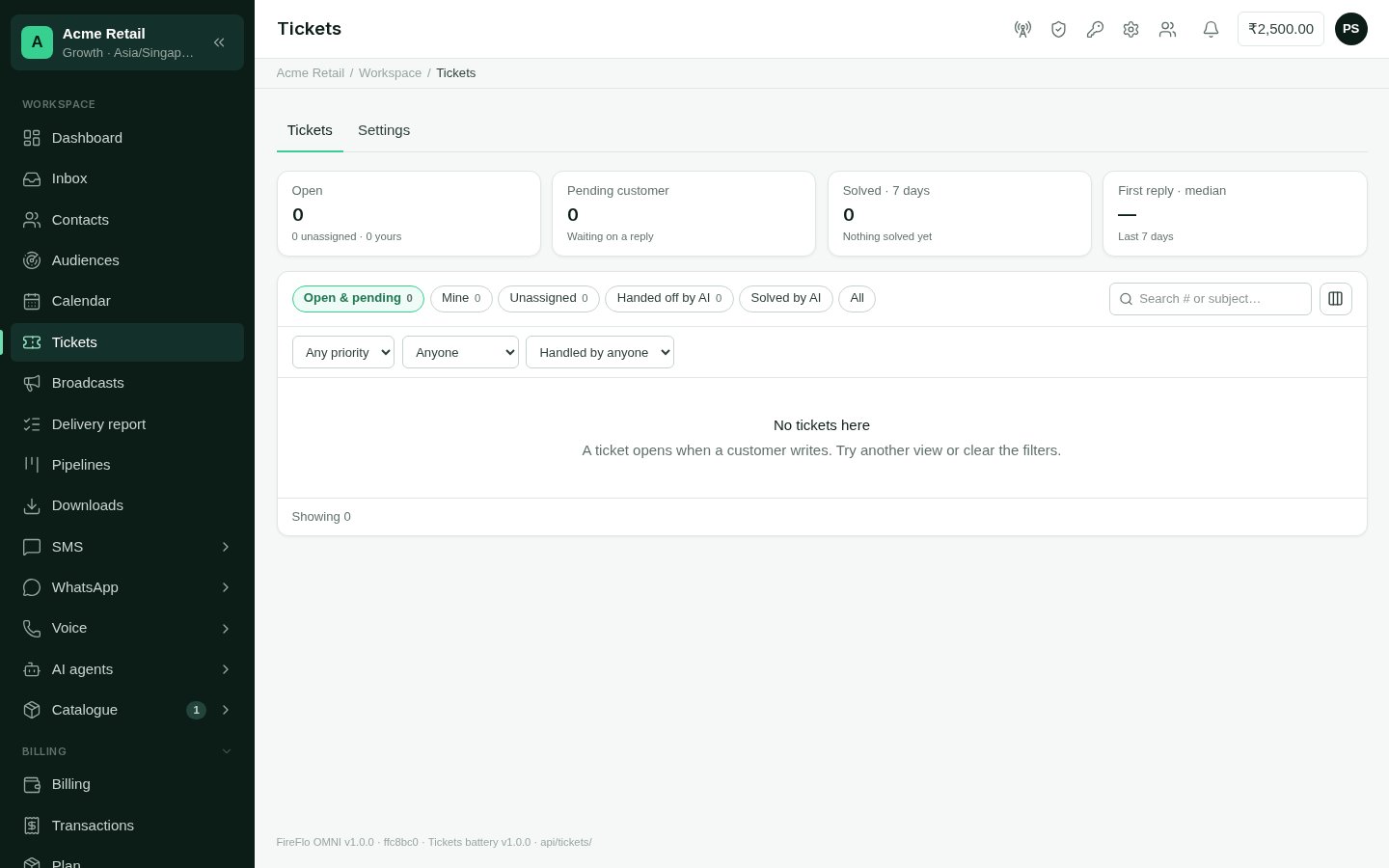 Tiles at the top show:
* **Open** — with how many are unassigned and yours;
* **Pending customer** — waiting on a reply;
* **Solved** in the last days — and how many of them by AI;
* **First reply · median** — over the last 7 days, and for people only.
Views: **Open & pending**, **Mine**, **Unassigned**, **Handed off by AI**, **Solved by AI**
and **All**. Search by number or subject, and filter by priority (**Normal**, **High**,
**Urgent**), category, assignee, who handled it (**AI**, **A person**, **AI → person**)
and status. You can hide columns you don't need.
## Settings
**Tickets → Settings** sets how threads are split into tickets.
| Setting | What it does |
| - | - |
| **Tickets on** | Turns tickets on or off for the account. |
| **Reopen window** | A reply within this many days reopens a solved ticket. Later, a new ticket starts and links to it. Default 3 days. |
| **Solve pending tickets** | A pending ticket the customer hasn't answered in this many days is solved. Default 3 days. |
| **Close solved tickets** | A solved ticket closes after this many days and can't reopen. Default 7 days. |
| **Keep the thread and its ticket in step** | Closing an Inbox thread solves its ticket, and solving a ticket closes the thread. On by default. |
| **Replies to broadcasts open tickets** | Whether a reply to a broadcast opens a ticket. On by default. |
### Categories
Categories are optional. Use them to filter and report tickets by what they're about —
"Returns & refunds", say. Give each a name and a colour. Deleting a category keeps its
tickets; they just lose the category.
### Earlier conversations
Conversations from before you had Tickets can be split into tickets once, by quiet gaps.
Say how many hours of quiet start a new ticket.
**See how many** tells you how many tickets would be made from how many conversations.
**Split earlier conversations** runs in the background. Past tickets are marked closed,
and you get a notice when it's done.
## With AI agents
When your plan also includes [AI Agents](/batteries/ai-agents):
* An agent gives the live ticket a clear subject, priority and category, and solves it
once the customer's problem is really settled. Support agents do this on their own by
default.
* When an agent hands a conversation to a person, it writes a short summary on the ticket
as a note, and the hand-over goes to whoever you chose with the fewest open tickets.
* Workflows gain **Ticket is** (new, reopened, ongoing or no ticket), **Set ticket** and
**Add ticket note** blocks.
* Solved tickets can suggest new FAQs for [Knowledge](/batteries/knowledge#suggested-faqs).
## Who may use Tickets
| Permission | Lets someone | Roles that have it by default |
| - | - | - |
| See tickets | Open the tickets list and see tickets in the Inbox | Owner, Admin, Support, Viewer |
| Change tickets, notes and ticket settings | Change status, priority, category and subject, add notes, and change settings and categories | Owner, Admin, Support |
An Owner or Admin can change these on the **Roles** screen. See
[Team and roles](/using/team-and-roles).
This documentation is built and hosted on [Mintlify](https://mintlify.com), a developer documentation platform.
Tiles at the top show:
* **Open** — with how many are unassigned and yours;
* **Pending customer** — waiting on a reply;
* **Solved** in the last days — and how many of them by AI;
* **First reply · median** — over the last 7 days, and for people only.
Views: **Open & pending**, **Mine**, **Unassigned**, **Handed off by AI**, **Solved by AI**
and **All**. Search by number or subject, and filter by priority (**Normal**, **High**,
**Urgent**), category, assignee, who handled it (**AI**, **A person**, **AI → person**)
and status. You can hide columns you don't need.
## Settings
**Tickets → Settings** sets how threads are split into tickets.
| Setting | What it does |
| - | - |
| **Tickets on** | Turns tickets on or off for the account. |
| **Reopen window** | A reply within this many days reopens a solved ticket. Later, a new ticket starts and links to it. Default 3 days. |
| **Solve pending tickets** | A pending ticket the customer hasn't answered in this many days is solved. Default 3 days. |
| **Close solved tickets** | A solved ticket closes after this many days and can't reopen. Default 7 days. |
| **Keep the thread and its ticket in step** | Closing an Inbox thread solves its ticket, and solving a ticket closes the thread. On by default. |
| **Replies to broadcasts open tickets** | Whether a reply to a broadcast opens a ticket. On by default. |
### Categories
Categories are optional. Use them to filter and report tickets by what they're about —
"Returns & refunds", say. Give each a name and a colour. Deleting a category keeps its
tickets; they just lose the category.
### Earlier conversations
Conversations from before you had Tickets can be split into tickets once, by quiet gaps.
Say how many hours of quiet start a new ticket.
**See how many** tells you how many tickets would be made from how many conversations.
**Split earlier conversations** runs in the background. Past tickets are marked closed,
and you get a notice when it's done.
## With AI agents
When your plan also includes [AI Agents](/batteries/ai-agents):
* An agent gives the live ticket a clear subject, priority and category, and solves it
once the customer's problem is really settled. Support agents do this on their own by
default.
* When an agent hands a conversation to a person, it writes a short summary on the ticket
as a note, and the hand-over goes to whoever you chose with the fewest open tickets.
* Workflows gain **Ticket is** (new, reopened, ongoing or no ticket), **Set ticket** and
**Add ticket note** blocks.
* Solved tickets can suggest new FAQs for [Knowledge](/batteries/knowledge#suggested-faqs).
## Who may use Tickets
| Permission | Lets someone | Roles that have it by default |
| - | - | - |
| See tickets | Open the tickets list and see tickets in the Inbox | Owner, Admin, Support, Viewer |
| Change tickets, notes and ticket settings | Change status, priority, category and subject, add notes, and change settings and categories | Owner, Admin, Support |
An Owner or Admin can change these on the **Roles** screen. See
[Team and roles](/using/team-and-roles).
This documentation is built and hosted on [Mintlify](https://mintlify.com), a developer documentation platform.