> ## Documentation Index
> Fetch the complete documentation index at: https://omni.fireflo.au/llms.txt
> Use this file to discover all available pages before exploring further.
# Webhooks
> One signed stream of events to your server: messages, every channel's deliveries and replies, and calls — how to receive them, check them, and what each carries.
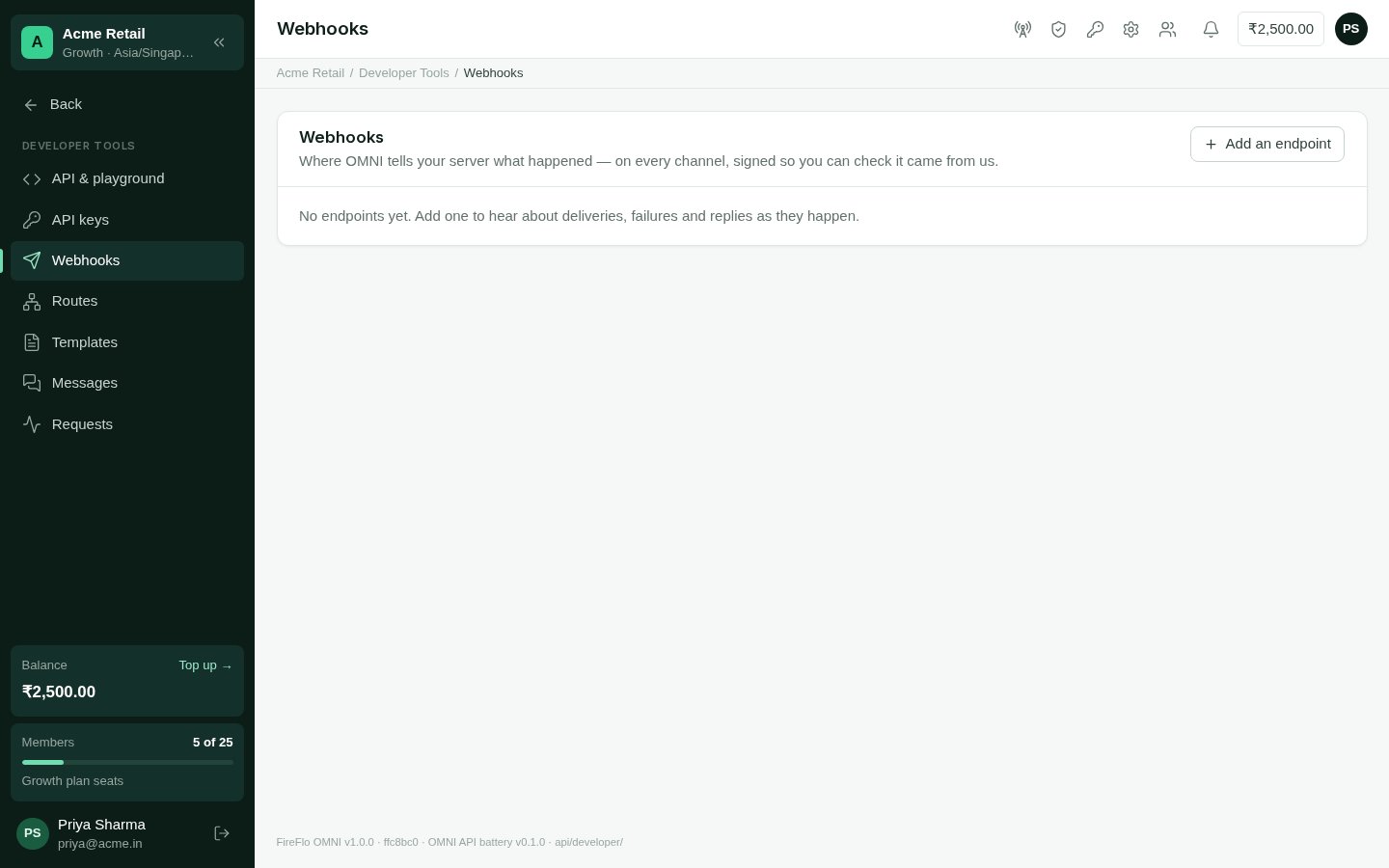
A webhook endpoint is an `https://` address on your server that OMNI tells about what
happened. Add endpoints in **Developer Tools → Webhooks**, or with `POST /v1/webhooks`; each
asks for the events it wants, or `*` for all of them, including events added later.
 ## What arrives
Each delivery is one `POST` with a JSON body:
```json theme={null}
{
"id": "evt_6f1c0a3b9d2e4f7a8b6c5d4e3f2a1b0c",
"event": "message.succeeded",
"created": "2026-10-05T11:42:11.902Z",
"data": { "message": { "id": "msg_4f1c…", "status": "succeeded", … } }
}
```
and these headers:
| Header | |
| :- | :- |
| `X-FireFlo-Signature` | `t=,v1=` — see below |
| `X-FireFlo-Event` | The event, e.g. `message.succeeded` |
| `X-FireFlo-Delivery` | This delivery's id — the same on every retry of it |
| `User-Agent` | `FireFlo-OMNI-Webhooks/1` |
Answer with any `2xx` within 10 seconds. Do slow work after answering. Redirects are not
followed.
## Checking the signature
Every delivery is signed with the endpoint's secret (`whsec_…`, shown once when the
endpoint is made, or when you make a new one). The signature is the HMAC-SHA256, in hex,
of `"."` — the timestamp, a full stop, and the raw body exactly as received.
Check it before trusting the body, and refuse deliveries whose `t` is more than a few
minutes old:
```python Python theme={null}
import hashlib, hmac, os, time
def verify(raw_body: bytes, header: str, secret=os.environ["OMNI_WEBHOOK_SECRET"]) -> bool:
parts = dict(part.split("=", 1) for part in header.split(","))
t, given = parts.get("t", ""), parts.get("v1", "")
if not t.isdigit() or abs(time.time() - int(t)) > 300:
return False
expected = hmac.new(secret.encode(), f"{t}.".encode() + raw_body, hashlib.sha256).hexdigest()
return hmac.compare_digest(expected, given)
```
```javascript Node theme={null}
import { createHmac, timingSafeEqual } from "node:crypto";
export function verify(rawBody, header, secret = process.env.OMNI_WEBHOOK_SECRET) {
const parts = Object.fromEntries(header.split(",").map((part) => part.split("=")));
if (!/^\d+$/.test(parts.t ?? "") || Math.abs(Date.now() / 1000 - Number(parts.t)) > 300) return false;
const expected = createHmac("sha256", secret).update(`${parts.t}.`).update(rawBody).digest("hex");
return expected.length === (parts.v1 ?? "").length && timingSafeEqual(Buffer.from(expected), Buffer.from(parts.v1));
}
```
```php PHP theme={null}
function verify(string $rawBody, string $header, string $secret): bool {
parse_str(str_replace(',', '&', $header), $parts);
$t = $parts['t'] ?? '';
if (!ctype_digit($t) || abs(time() - (int) $t) > 300) return false;
$expected = hash_hmac('sha256', $t . '.' . $rawBody, $secret);
return hash_equals($expected, $parts['v1'] ?? '');
}
```
```ruby Ruby theme={null}
require "openssl"
def verify(raw_body, header, secret = ENV["OMNI_WEBHOOK_SECRET"])
parts = header.split(",").map { |part| part.split("=", 2) }.to_h
t = parts["t"].to_s
return false unless t.match?(/\A\d+\z/) && (Time.now.to_i - t.to_i).abs <= 300
expected = OpenSSL::HMAC.hexdigest("SHA256", secret, "#{t}.#{raw_body}")
OpenSSL.secure_compare(expected, parts["v1"].to_s)
end
```
Use the raw body bytes. A body parsed and re-encoded by your framework will not match.
## Retries, and an endpoint switched off
A delivery not answered `2xx` is tried again after **30 seconds, 5 minutes, 30 minutes,
2 hours and 12 hours**, then given up. An endpoint that has failed for **three days**
without a single success is switched off, and says so in the panel; switch it back on
once it's fixed.
Deliveries can arrive more than once and out of order. Use `X-FireFlo-Delivery` (or the
event's `id`) to ignore a repeat, and the times in `data` rather than arrival order.
Every endpoint's deliveries — each event, its answer and its tries — are in
**Developer Tools → Webhooks → the endpoint**, where any of them can be sent again, and in
`GET /v1/webhooks/{endpoint_id}/deliveries`. **Send a test** sends a `webhook.test` event
at once.
## Events
### A message, with failover
`data.message` is the message as [`GET /v1/messages/{message_id}`](/api-reference/messages/get)
shows it, with every attempt.
| Event | When |
| :- | :- |
| `message.attempted` | A step handed the message to a channel |
| `message.failed_over` | A step didn't get there; the next one is trying |
| `message.succeeded` | A step reached its goal (`outcome` says which channel, and how far) |
| `message.failed` | Every step was tried, or the person may not be reached |
| `message.expired` | It ran out of time before it got there |
| `message.canceled` | It was canceled |
### A message on a channel
Every message any channel carries — sent through the API, a broadcast, the Inbox or an
AI agent. `data.channel_message`:
```json theme={null}
{
"id": "cm_88123",
"channel": "sms",
"direction": "outbound",
"to": "+919876543210",
"from": "FIRFLO",
"status": "delivered",
"text": "Hi Ravi, your order A-1043 has shipped.",
"error": "",
"campaign": null,
"created": "2026-10-05T11:42:07.164Z",
"status_at": "2026-10-05T11:42:11.902Z"
}
```
| Event | When |
| :- | :- |
| `channel_message.received` | Someone sent you a message, on any channel |
| `channel_message.sent` | A message was handed to its channel |
| `channel_message.delivered` | It reached the phone |
| `channel_message.read` | It was read |
| `channel_message.failed` | It couldn't be delivered |
### A call
`data.call` is the call as [`GET /v1/calls/{call_id}`](/api-reference/calls/get) shows
it, with its `channel`.
| Event | When |
| :- | :- |
| `call.started` | A call started, either way |
| `call.answered` | It was answered |
| `call.ended` | It ended after being answered |
| `call.failed` | A call you placed wasn't answered |
| `call.missed` | A call rang in and nobody took it |
### Testing
`webhook.test` — sent only when you ask, with `data.endpoint` naming the endpoint.
This documentation is built and hosted on [Mintlify](https://mintlify.com), a developer documentation platform.
## What arrives
Each delivery is one `POST` with a JSON body:
```json theme={null}
{
"id": "evt_6f1c0a3b9d2e4f7a8b6c5d4e3f2a1b0c",
"event": "message.succeeded",
"created": "2026-10-05T11:42:11.902Z",
"data": { "message": { "id": "msg_4f1c…", "status": "succeeded", … } }
}
```
and these headers:
| Header | |
| :- | :- |
| `X-FireFlo-Signature` | `t=,v1=` — see below |
| `X-FireFlo-Event` | The event, e.g. `message.succeeded` |
| `X-FireFlo-Delivery` | This delivery's id — the same on every retry of it |
| `User-Agent` | `FireFlo-OMNI-Webhooks/1` |
Answer with any `2xx` within 10 seconds. Do slow work after answering. Redirects are not
followed.
## Checking the signature
Every delivery is signed with the endpoint's secret (`whsec_…`, shown once when the
endpoint is made, or when you make a new one). The signature is the HMAC-SHA256, in hex,
of `"."` — the timestamp, a full stop, and the raw body exactly as received.
Check it before trusting the body, and refuse deliveries whose `t` is more than a few
minutes old:
```python Python theme={null}
import hashlib, hmac, os, time
def verify(raw_body: bytes, header: str, secret=os.environ["OMNI_WEBHOOK_SECRET"]) -> bool:
parts = dict(part.split("=", 1) for part in header.split(","))
t, given = parts.get("t", ""), parts.get("v1", "")
if not t.isdigit() or abs(time.time() - int(t)) > 300:
return False
expected = hmac.new(secret.encode(), f"{t}.".encode() + raw_body, hashlib.sha256).hexdigest()
return hmac.compare_digest(expected, given)
```
```javascript Node theme={null}
import { createHmac, timingSafeEqual } from "node:crypto";
export function verify(rawBody, header, secret = process.env.OMNI_WEBHOOK_SECRET) {
const parts = Object.fromEntries(header.split(",").map((part) => part.split("=")));
if (!/^\d+$/.test(parts.t ?? "") || Math.abs(Date.now() / 1000 - Number(parts.t)) > 300) return false;
const expected = createHmac("sha256", secret).update(`${parts.t}.`).update(rawBody).digest("hex");
return expected.length === (parts.v1 ?? "").length && timingSafeEqual(Buffer.from(expected), Buffer.from(parts.v1));
}
```
```php PHP theme={null}
function verify(string $rawBody, string $header, string $secret): bool {
parse_str(str_replace(',', '&', $header), $parts);
$t = $parts['t'] ?? '';
if (!ctype_digit($t) || abs(time() - (int) $t) > 300) return false;
$expected = hash_hmac('sha256', $t . '.' . $rawBody, $secret);
return hash_equals($expected, $parts['v1'] ?? '');
}
```
```ruby Ruby theme={null}
require "openssl"
def verify(raw_body, header, secret = ENV["OMNI_WEBHOOK_SECRET"])
parts = header.split(",").map { |part| part.split("=", 2) }.to_h
t = parts["t"].to_s
return false unless t.match?(/\A\d+\z/) && (Time.now.to_i - t.to_i).abs <= 300
expected = OpenSSL::HMAC.hexdigest("SHA256", secret, "#{t}.#{raw_body}")
OpenSSL.secure_compare(expected, parts["v1"].to_s)
end
```
Use the raw body bytes. A body parsed and re-encoded by your framework will not match.
## Retries, and an endpoint switched off
A delivery not answered `2xx` is tried again after **30 seconds, 5 minutes, 30 minutes,
2 hours and 12 hours**, then given up. An endpoint that has failed for **three days**
without a single success is switched off, and says so in the panel; switch it back on
once it's fixed.
Deliveries can arrive more than once and out of order. Use `X-FireFlo-Delivery` (or the
event's `id`) to ignore a repeat, and the times in `data` rather than arrival order.
Every endpoint's deliveries — each event, its answer and its tries — are in
**Developer Tools → Webhooks → the endpoint**, where any of them can be sent again, and in
`GET /v1/webhooks/{endpoint_id}/deliveries`. **Send a test** sends a `webhook.test` event
at once.
## Events
### A message, with failover
`data.message` is the message as [`GET /v1/messages/{message_id}`](/api-reference/messages/get)
shows it, with every attempt.
| Event | When |
| :- | :- |
| `message.attempted` | A step handed the message to a channel |
| `message.failed_over` | A step didn't get there; the next one is trying |
| `message.succeeded` | A step reached its goal (`outcome` says which channel, and how far) |
| `message.failed` | Every step was tried, or the person may not be reached |
| `message.expired` | It ran out of time before it got there |
| `message.canceled` | It was canceled |
### A message on a channel
Every message any channel carries — sent through the API, a broadcast, the Inbox or an
AI agent. `data.channel_message`:
```json theme={null}
{
"id": "cm_88123",
"channel": "sms",
"direction": "outbound",
"to": "+919876543210",
"from": "FIRFLO",
"status": "delivered",
"text": "Hi Ravi, your order A-1043 has shipped.",
"error": "",
"campaign": null,
"created": "2026-10-05T11:42:07.164Z",
"status_at": "2026-10-05T11:42:11.902Z"
}
```
| Event | When |
| :- | :- |
| `channel_message.received` | Someone sent you a message, on any channel |
| `channel_message.sent` | A message was handed to its channel |
| `channel_message.delivered` | It reached the phone |
| `channel_message.read` | It was read |
| `channel_message.failed` | It couldn't be delivered |
### A call
`data.call` is the call as [`GET /v1/calls/{call_id}`](/api-reference/calls/get) shows
it, with its `channel`.
| Event | When |
| :- | :- |
| `call.started` | A call started, either way |
| `call.answered` | It was answered |
| `call.ended` | It ended after being answered |
| `call.failed` | A call you placed wasn't answered |
| `call.missed` | A call rang in and nobody took it |
### Testing
`webhook.test` — sent only when you ask, with `data.endpoint` naming the endpoint.
This documentation is built and hosted on [Mintlify](https://mintlify.com), a developer documentation platform.