
https:// address on your server that OMNI tells about what
happened. Add endpoints in Developer Tools → Webhooks, or with POST /v1/webhooks; each
asks for the events it wants, or * for all of them, including events added later.
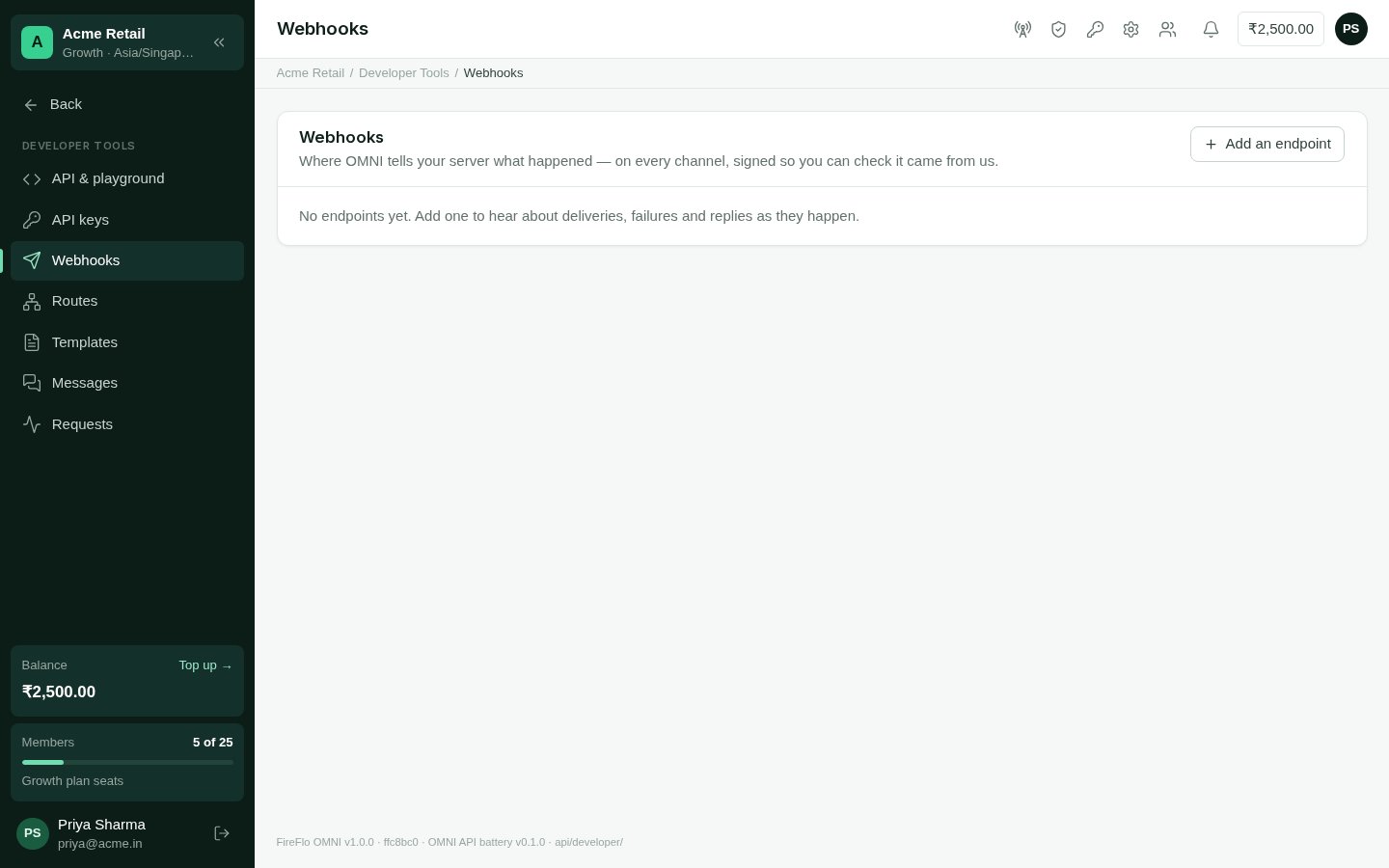
Developer Tools → Webhooks
What arrives
Each delivery is onePOST with a JSON body:
Answer with any
2xx within 10 seconds. Do slow work after answering. Redirects are not
followed.
Checking the signature
Every delivery is signed with the endpoint’s secret (whsec_…, shown once when the
endpoint is made, or when you make a new one). The signature is the HMAC-SHA256, in hex,
of "<t>.<body>" — the timestamp, a full stop, and the raw body exactly as received.
Check it before trusting the body, and refuse deliveries whose t is more than a few
minutes old:
Retries, and an endpoint switched off
A delivery not answered2xx is tried again after 30 seconds, 5 minutes, 30 minutes,
2 hours and 12 hours, then given up. An endpoint that has failed for three days
without a single success is switched off, and says so in the panel; switch it back on
once it’s fixed.
Deliveries can arrive more than once and out of order. Use X-FireFlo-Delivery (or the
event’s id) to ignore a repeat, and the times in data rather than arrival order.
Every endpoint’s deliveries — each event, its answer and its tries — are in
Developer Tools → Webhooks → the endpoint, where any of them can be sent again, and in
GET /v1/webhooks/{endpoint_id}/deliveries. Send a test sends a webhook.test event
at once.
Events
A message, with failover
data.message is the message as GET /v1/messages/{message_id}
shows it, with every attempt.
A message on a channel
Every message any channel carries — sent through the API, a broadcast, the Inbox or an AI agent.data.channel_message:
A call
data.call is the call as GET /v1/calls/{call_id} shows
it, with its channel.
Testing
webhook.test — sent only when you ask, with data.endpoint naming the endpoint.